

In his recently published book, Climb: Uncover the Secrets Behind Extraordinary Career Success, Ritchie Mehta and his co-author Mark Evans set out to answer a question that had been nagging them both for many years: what does it actually take to build a career that is both successful and fulfilling?
Not the sanitised version. Not the LinkedIn highlight reel. The real story, including the rejections, the pivots, the moments of self-doubt that somehow became turning points. In this article Ritchie shares the thinking behind the book and what they discovered.
Why we wrote the book
We had both felt it ourselves. Mark had climbed to the Executive Team of a FTSE 100 company before choosing to pivot out of corporate life. I had left feeling stuck on the ladder, determined to forge a different path. We knew we weren't alone. Talented people everywhere were working harder than ever yet feeling less fulfilled, stuck in roles that no longer excited them, wondering: is this really it? That question feels more urgent now than ever.
The Great Reset: why careers are changing faster than ever
AI is not just changing the tools we use, it is reshaping the very nature of careers. The World Economic Forum estimates that 39 per cent of current skills will be outdated within five years, we believe that is an understatement. AI-native companies are reaching $100 million in revenue with tiny teams, and the race is on for the first billion-dollar company run by a single person. This is what we call the Great Reset, and it demands a fundamentally new approach to how we build, navigate and future-proof our careers.
What 200 leaders taught us about success
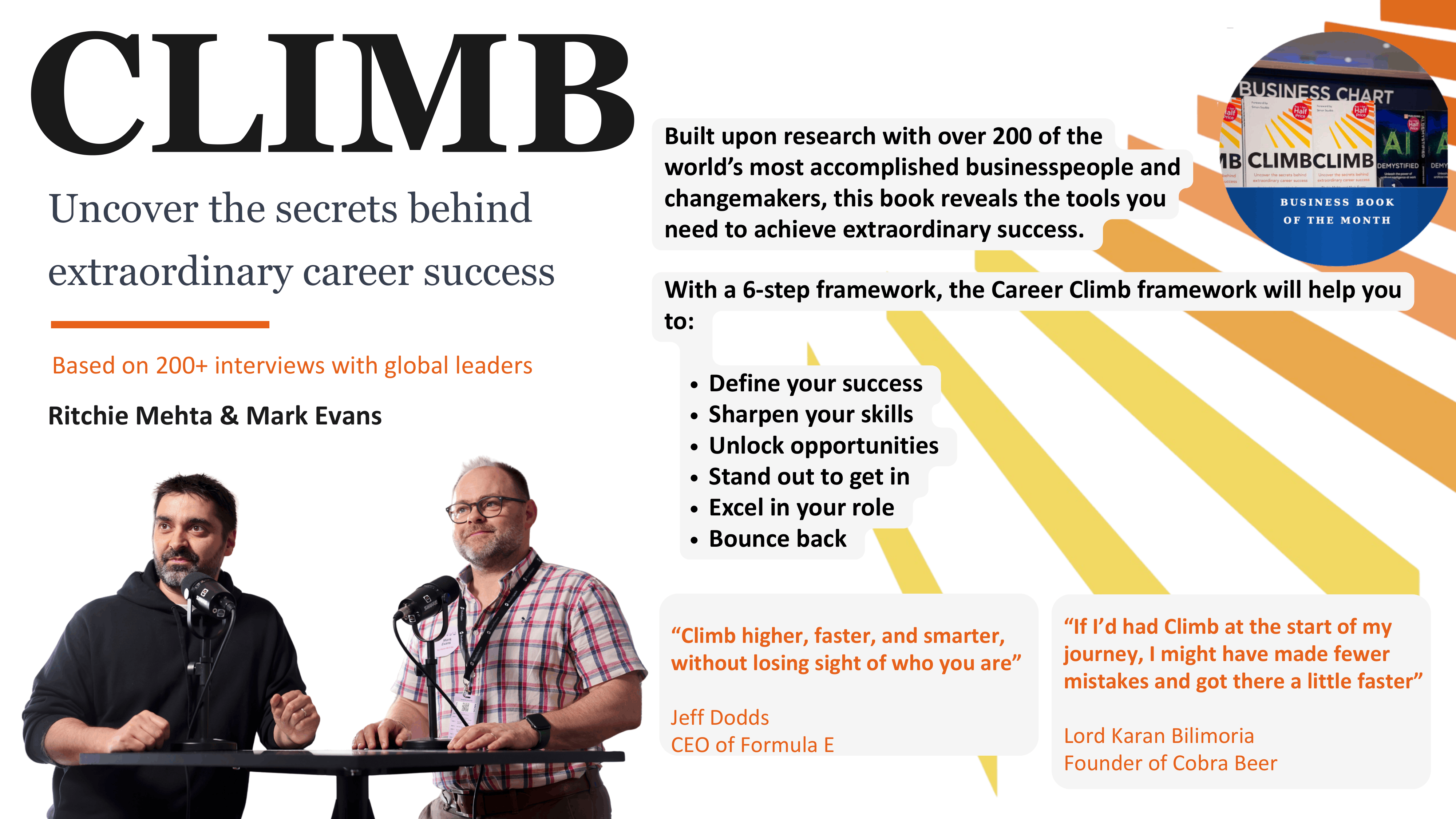
So we went in search of answers. Over five years, we interviewed and researched more than 200 leaders across six continents, from CEOs and CMOs to founders, sports stars and entrepreneurs. What we found changed our understanding of career success completely. The result is CLIMB, published by Pearson.
The conscious climb: stories from the people who've done it
A striking pattern emerged: every one of them had made what we came to call a "conscious climb." Their paths were far from linear. Many faced rejection, reinvention and recalibration but they shared a commitment to growing, learning and adapting with purpose. Crucially, they saw change, including the rise of AI, not as a threat but as an accelerant, embracing it to supercharge their skills and impact.
Take Guy Kawasaki, who walked away from Apple, twice, because he valued new experiences over the safety of a pay cheque. Or Karen Blackett CBE, who zig-zagged through 27 years in advertising and media, making lateral moves that gave her the breadth to lead WPP as Country Manager. Consider Sharry Cramond, now Marketing Director at Marks & Spencer, who reframed what made her different into her greatest career advantage - or Fernando Machado, former CMO of Burger King behind the brilliantly audacious Mouldy Whopper, whose advice is disarmingly simple: build your career one brick at a time.
Professor Robert Cialdini shared how a single conversation nearly sent his career in an entirely different direction. Rory Sutherland, Vice Chairman of Ogilvy UK, describes the book as a compass rather than a map. And we drew on insights from leaders at Diageo, Google, Estée Lauder, Santander, NatWest and Formula E, alongside figures like Sir Clive Woodward, Mo Gawdat and Steven Bartlett.
A practical framework for your career
What emerged is a practical framework built around six areas: defining your own version of success, sharpening the skills that matter in an AI-driven world, creating your own opportunities, standing out when it counts, excelling in a new role and bouncing back from failure.
This isn't a book of theory. Every chapter includes tools, exercises and templates you can use immediately, whether you are a marketing director weighing your next move, an aspiring CMO building your case, or someone earlier in their career finding their footing.
As Simon Squibb writes in the foreword, "your career shouldn't be a trap, it should be a launchpad".
Climb: Uncover the Secrets Behind Extraordinary Career Success is available to order on Amazon.