
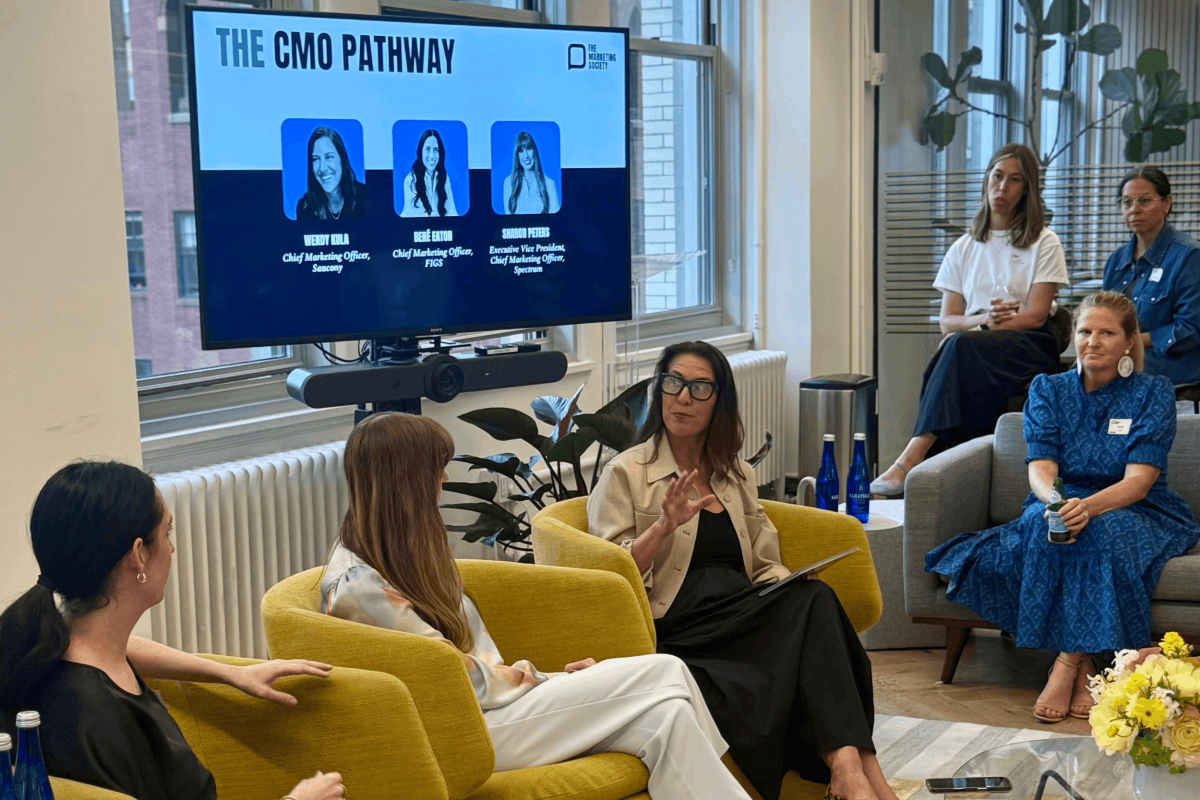
The CMO role has fundamentally changed. Once a functional leadership position, it is now one of the most demanding seats in any C-suite, requiring commercial fluency, cross-functional influence, and the ability to lead well beyond the boundaries of marketing. At an intimate evening session hosted at VCCP New York, two seasoned CMOs joined moderator Wendy Kula, herself 10 days into her new role as CMO of Saucony, to speak candidly about what the leap to the top really takes.
5 Key Points
The CMO role is not marketing at a bigger scale
The most persistent misconception is that becoming a CMO is simply a larger version of what came before. Sharon Peters was direct: the jump is about altitude, not scale. You are no longer the expert in a function. You are the steward of a brand that others must deliver. That means influencing peers, speaking credibly to the CEO, and understanding that the brand is built through every customer experience across the whole organization, not just what marketing says or creates.Widen the aperture, and hire for your blind spots
Bené Eaton described stepping into the CMO role as a fundamental shift in how you operate. You cannot be the expert in everything, from AI and performance marketing to operations and creative. The job demands that you trust the experts in your team, ask questions relentlessly, and deliberately hire people who are stronger than you in the areas where you are not. Knowing where you can genuinely contribute, and where you need to bring someone else to the table, is a defining skill.Relationships are the real infrastructure
Both speakers returned to this theme repeatedly. The relationships you build, not just professionally but on a human level, are what make you effective in the CMO role. They also acknowledged that leadership can be surprisingly lonely, making trusted peers and mentors an essential sounding board when navigating difficult decisions and challenges. Sharon built trust with her CEO and CFO over time, to the point where marketing budgets were protected even in difficult cycles. Bené flew to Santa Monica every other week in her first months at FIGS, simply to get to know her team properly. That investment paid off. People knew she was in it with them, and the trust that followed shaped everything.Commercial fluency is non-negotiable
CMOs who want to be taken seriously as business leaders must understand how their work connects to the wider commercial picture. Sharon described the goal as getting the CFO and CEO to see marketing as an investment rather than a cost. That requires knowing what drives them, demonstrating impact clearly, and building a track record of accountability. Bené spoke about the alignment that comes from working for a founder-led organization where the CEO shares the same long-term vision for brand building.Mental agility is the job
Both speakers described the sheer breadth of what a modern CMO is expected to hold in their heads at any one time. Sharon described moving between topics across a single day, from rural broadband rollout to AI to product to creative, with no slow transition between them. Bené talked about wearing bifocal lenses: being in the detail with her team one moment, then presenting to investors and the board the next. The ability to shift register quickly, and do both credibly, is not a nice-to-have. It is the job.There is a version of the CMO story that most people learn before they get there. It goes something like this: work hard, build your expertise, lead increasingly large teams, and eventually you will earn the top seat. What nobody quite prepares you for is that the top seat requires an almost entirely different set of skills from the ones that got you there.
That was the thread running through the entire conversation at VCCP New York, where Sharon Peters, EVP and CMO at Charter Communications, and Bené Eaton, CMO at FIGS, spoke with candid honesty about what making that leap actually looks like.
The Transition From Marketer to Business Leader
Sharon put it plainly. The CMO is not the sum of all the marketing roles before it, just bigger. The shift is about operating at enterprise level, understanding the whole business, and recognising that you can make a brand promise all you like, but it is every other function in the company that delivers on it. Your job is to influence those functions, earn their trust, and speak their language. That is a different job from being a brilliant marketer.
Bené agreed, adding that the aperture simply has to widen. At previous companies she had been close to the work in a particular domain. As a CMO, she is working with finance, with retail and inventory partners, with technology teams, and doing it seamlessly. The cross-functional depth required is significant, and she was clear that you cannot fake it. You have to invest time, ask questions, and hire people whose strengths complement your own gaps.
Why Relationships Matter More Than Ever
The theme of relationships came up again and again throughout the evening, and for good reason. Sharon described deliberately creating time to understand what motivates each of her peers and her team, as people, not just as colleagues. She was frank about the fact that it takes effort and intention, and that there are never quite enough hours to do as much of it as you would like. But it matters. The trust she has built with her CEO and CFO over a decade means that when budgets get tight, marketing is the last line of cut, not the first. That is not luck. That is the result of years of relationship building and demonstrating value consistently.
Bené spoke about her first months at FIGS, where she travelled from New York to the company headquarters in Santa Monica every other week to spend time with her team. She has three children and a husband who is also a doctor. It was not easy. But she was clear that it was absolutely worth it, because the foundation of trust she built in those early months has shaped everything since. Her team knows she is with them. She knows them. And that changes how you operate together.
Thriving in the Complexity of the CMO Role
On the question of commercial fluency, both speakers were emphatic. You have to understand how marketing connects to the business. You have to speak the language of the CFO, know what the CEO is focused on, and help them see marketing as an investment rather than an overhead. Bené described working in a founder-led company where the CEO and co-founder shares her long-term vision for the brand, which she acknowledged is a rare and fortunate position. Sharon talked about the discipline of proving impact and building credibility gradually, so that over time she no longer has to justify every decision from scratch.
On the question of how to actually do the job day to day, both speakers were honest about the mental load. Sharon described her day as a rapid-fire sequence of entirely different subjects, from rural broadband rollout to AI to product strategy to creative review. Bené described the bifocal lens she has had to develop, toggling between being in the detail with her team and presenting at board or investor level, sometimes within the same hour. Neither pretended this was easy. Both said it was simply the reality of the role, and that loving the work, and the community you are serving, is what makes it sustainable.
The evening closed with advice for ambitious marketers who want to make the step. Sharon was characteristically direct: become your CMO's right hand. Show up for everything. Come with solutions, not problems. And make sure the trust between you is real, not transactional. Bené added that relationships extend beyond your current company. The network she built at Nike, Ralph Lauren, and Under Armour is still one of her most valuable resources. When you are the sole person representing marketing at the leadership table, knowing who you can call is not a bonus. It is how you stay sharp.
3 Take aways
The step to CMO is a change of remit, not a change of scale
The skills that make a brilliant senior marketer are necessary but not sufficient. Commercial fluency, enterprise thinking, and the ability to influence far beyond the marketing function are what the role actually demands.Relationships are the foundation of everything
Building genuine human connections with your team, your peers, and your leadership, before you need them, is the most high-leverage investment you can make. Trust is not built in a moment. It is built in the ordinary, consistent moments before anything goes wrong.Edit to amplify
Every CMO in the room was wrestling with the same challenge: too many opportunities, not enough capacity. The discipline of deciding what not to do, and focusing the team's energy where it will have the greatest impact, is as important as any creative or strategic skill.2 Action Items
Map your influence beyond marketing
Identify two or three peers in functions outside your own and invest in understanding what they are working on, what motivates them, and where your work intersects. Start building those relationships before you need them.Audit where you hire for strength versus where you rely on your own
Be honest about where your blind spots are and make a deliberate plan to bring people in around you who are stronger in those areas. Knowing what you do not know, and acting on it, is a core CMO capability.
"The best brands in the world don't sell products. They create meaning and really invite their customer, their community, to be a part of something bigger than themselves."
Bené Eaton FIGS