
The world is a busy place. Earning customers’ decisions takes more than a strong product or service. The whole experience needs to be strong. Easy, appropriately enjoyable, in some way making life better so people feel good about making their choice.
This means organisations need to work harder than they used to, creating value beyond a transaction and ensuring touchpoints reflect their brand’s values and personality.
From Strategy to Reality: The Implementation Challenge
It sounds simple, but when we’re caught in a tangled web of brand models, missions, values, and purpose statements, it can be hard to turn the conceptual soup into the real world of a meaningfully different and consistent brand experience in the real world.
Customers come into contact with brands in multiple ways, sometimes many times a day – an ad on TikTok, a conversation with friends, searching on Google, seeing a newsletter, passing on a High Street, exploring a store or showroom, talking to a staff member, making a call, buying something, sorting out a problem... as well as memories of all of these things into the past.
Creating a brand experience intentionally demands consistency. Whether a customer interacts online, through social media or in a store, they should find a unified, cohesive message and feel. The consistency builds trust and reinforces the brand’s core message.
Breaking Down Organisational Silos
For this to happen, the brand experience needs to be understood, prioritised and owned by everyone in the organisation. An easier thing to say than do. Is the customer experience team working with the brand team? Does the web team talk to operations? Is the innovation team alongside the marketers?
Working in silos, each team guided by their own priorities, leads to customer experiences that are generic at best and incoherent at worst.
What’s needed to draw people together across silos is an understanding of brand that acts as the organisation’s North Star, directing every customer interaction, inspiring brand-centric innovation, ensuring decisions are made that won’t unintentionally conflict with the brand’s values and proposition.
Without this, it’s easy to get blown off course by knee-jerk reactions to last month’s numbers or impulsive actions from a bright idea in a team not thinking holistically.
When organisations work with their brand front and centre, they work in ways that, over time, differentiate them, with a customers’ experiences setting them apart from the rest.

"The branded part of the experience needed to be built on strong foundations – essentials that simply work"
Good, functional customer experiences are not the norm. Data from The Foundation’s nationally representative survey conducted in late 2023 found that 85% of customers believe organisations feel impersonal and have lost their 'human' touch, 83% believe organisations take their customers for granted and 81% believe organisations are more interested in cutting costs than creating good experiences.
They have a point. Most organisations take an inside-out approach, focused on what matters to them not what matters to their customers.
It’s natural. Leaders in any organisation are closer to colleagues than they are to customers. KPIs and remuneration starts with quantitative performance and meeting the needs of other stakeholders, like a regulator, also looms large. The quality of what customers experience is further down the list – customers are quiet.
In terms of managing a customer experiences, being inside-out leads to unhelpful behaviours:
- Pestering customers for feedback
- Reactively fixing pain points
- Prioritising by complaints
- Subscribing to generic frameworks
- Confusing customer experience with customer service
- Obsessing over a single number
Some organisations break out. We call them Customer Pioneers and they go first, ahead of competitors, trailblazing on behalf of their customers. They tackle pain points that convention previously accepted as unavoidable, and they give customers what they didn’t even know they needed, new and better solutions to their problems.
Their secret? Their whole approach is outside-in. That means they see the world from where their customers stand, understanding the fundamental problems customers need to solve or the outcomes they want, then finding new and better solutions. The design experiences that make their customers’ lives better and as a result they earn more decisions in their favour – decisions to join, to stay, to do more and to recommend.
The five things that working outside-in means for customer experience design and delivery
1. Understand the customer experience is the sum of many parts
Always remember that the way a customer feels is a result of every interaction with a brand or organisation. So customer experience covers product, service, communication and all that affects them – policies, operations, recruitment, reward. It starts when a customer first hears about the brand and it continues from there – so it means considering not just existing customers but potential and past customers too. It is the reality of a brand that comes after the marketing promise.
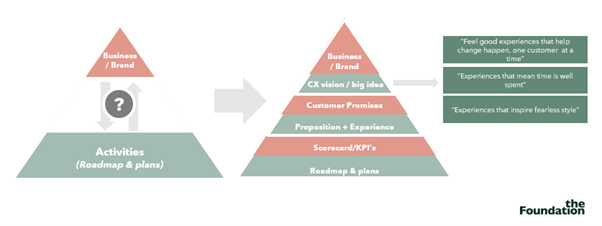
2. Use brand as a golden thread from strategy to execution, guiding the customer experience
A simple framework shows where the brand fits in, turning a few strong insights and principles around brand positioning and personality into a fully defined experiences summed up in customers promises and a continual improvement system with measurement at its heart.
3. Codify the brand experience
Sum up the intended experiences by establishing clear ‘customer promises’. They express what you’re committing to deliver to customers and they give teams clarity in the parts they play. They form the basis for customer-led KPIs which allow the organisation to monitor and continually improve the experience provided.
4. Use customer experience as a strategic tool
A strong customer experience can be used to acquire new customers through differentiation, and to retain and deepen relationships with existing customers. It does this by:
Building differentiation – defining distinct, memorable parts of the experience, in line with the brand's identity and values, that will stand out from competitors
Creating delight – seeing opportunities to go beyond customer expectations, doing better in areas that matter most.
Reducing dismay - address areas of the experience that lead to dissatisfaction, frustration or disappointment
As a result of all of this, you will do better as a business, earning more customer decisions to join (acquisition), stay (retention), do more (cross-sell and advocate), and in some cases do less (resolve issues and complain).
5. Use the promises and measurement to continuously improve
Set up to learn from customers, taking a systematic approach based on the promises to measure, prioritise, design and deploy improvements, and keep on monitoring performance in a cycle.
Learning from some great customer pioneer examples
Lick Paint are pioneering in the home decor market. They saw that too many customers felt unsupported when shopping for paint and set out to make it better. Their mission; to support customers through education and inspiration and create a people-powered decorating movement that does good and looks good too. The mission shines through the customer experience, from content, to packaging, to product, they have thought through every aspect of the decorating experience; choosing, testing and applying:
Democratising interior design:
- They have inspiring and educational content to help customers feel confident in the process of transforming their home.
- They champion open access to the interior and colour expert world and employ colour specialists to offer support on site or via video call colour consultations.
Demystifying choice:
- No more far-fetched paint names, they simplified convention, reducing the range to just 100 shades, simply named by a colour plus a number indicating how light or dark in tone it is e.g. Green 07
- Pioneering hassle-free testing and application:
- They did away with sample pots and use tester stickers that peel on and off and can be moved around meaning no damage to walls while customers see colours in different spaces, lights and times of day.
- They use cans with screw tops that are easy to pour – no more prizing open with a screwdriver and glooping all over the floor.
- They even give you a Lick stirrer stick – no more picking bits of twig out of your new paint...
Alpkit is a UK-based outdoor gear company, known for its values of quality, sustainability, and community. They offer affordable, durable gear with in-store expert staff, plus a commitment to recycling, repair and post-purchase support. They use multiple touchpoints to make adventure accessible and responsible. The brand experience fosters trust and loyalty among customers who value the outdoors and want to have a positive impact on the planet.
Lush create a memorable brand and customer experience by mixing ethical values with a sensory and personalised customer journey. It has unique products, an engaging in-store experience, a strong commitment to sustainability and customer-centric service, It’s built a brand experience that resonates deeply with its audience and has turned customers into passionate brand advocates.
These brands each understand that brand experience has to continuously evolve in line with customer expectations and technology. The brands that stand out are those that are constantly looking for ways to innovate and improve, build around a solid set of principles and beliefs.
Brand experience is a strategic asset that shapes customer perceptions, fosters loyalty, and leads to healthy growth. By aligning customer experience with brand values, organisations build lasting connections with their customers, ultimately earning a position of trust and preference.
The brands that succeed are those that build their identity into every customer interaction, on top of doing the essentials well. The result – a cohesive experience that earns customers’ decisions and advocacy.
Authored by Charlie Dawson and Anna Miley, Partners at The Foundation