
All companies do market research – even the ones that claim not to. The reality is that companies exist to serve markets – and whatever their product or service, whatever their ownership structure, they are trying to provide something that their customer wants, when and where they want it, at a price they can accept – and often in competition with other providers of a similar product or service. Other articles in this series will look at important topics like assessing brand performance and global marketing – and all of them will include an element of market research.
Indeed, you could ascribe all corporate failure to an asymmetry between the beliefs of those managing the company and their customers - ultimately a failure of market research. That can be because the customers have changed and the company has failed to change with them - or the customers have not changed and the company has changed in a way that no longer meets the needs of those customers.
Breaking it down
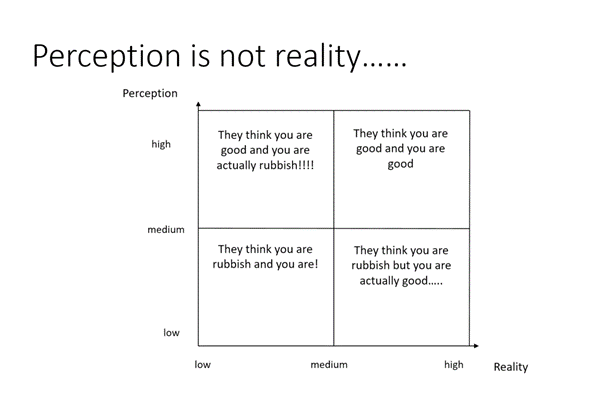
At its simplest most market research is focused on identifying customer needs, assessing gaps in what the market is currently providing – and reducing risk in decision making. For many years as a marketing director I used this chart as a reality check where we tried to agree which box we were in. Customers and companies can be prey to dangerous delusions.
Companies, irrespective of size and scale, recognise some useful principles that underpin market research – the simplest being that information should cost less to gather than its value to whoever is gathering it. Collecting and analysing information is something that all companies do – and indeed one of the simplest and cheapest forms of market research is to look at existing sales figures. All companies know what they sell and when and where they sell it – but they may not know why and what they would need to do to sell more.
This curiosity is what drives a lot of market research. Understanding your market and the behaviour of your customers is a key responsibility. There are competing forces here too. An old Phoenician proverb states that one fool can ask more questions than a thousand wise men can answer. The risk for all managers is to be sure that they are not the fool – constantly asking questions that are interesting to them – and which absorb time and money in being answered – but to little useful effect. The corollary is that a failure to ask the right questions can blind you to the reality of your situation. I won’t add another matrix but it can be useful to consider whether the questions you are asking are both interesting and useful.
The most important questions that marketers tend to ask look like these:
- Are potential customers aware of my product/service?
- Is my product/service as good as my competitors and does that affect my revenue?
- Will my advertising/communications work in delivering awareness and revenue?
- Will my new product/service launch succeed?
- How can we get our customers to do x (which is good for our profitability) rather than y (which is not)?
The Challenge of Research Reliability
Whatever method is used to try and answer these – be it primary or secondary research, qualitative or quantitative, it is always useful to think about the reliability of any answers. There are a lot of factors that can influence reliability of response! Claimed vs actual behaviour is relatively well understood (we often don’t do what we say we are going to do!). More recently we have a lot of evidence of the fallibility of human memory and experience (we aren’t great at recalling what we have done), the importance of how any questions are framed (other information affects and distorts our memories further), the order in which questions are asked, the power of emotion (how we feel at the time we are asked, as well as how we felt when the experience we are being asked about occurred (emotion codes memory).
Who we are asking matters too – as does how they were recruited – and in a world of artificial “intelligence” and “synthetic” respondents we cannot even be sure they are a real person unless they are physically in front of us. Even video research can be affected by whoever is doing the camera work, unless we are asking respondents to record themselves. Who you are asking; what, when and how you are asking them – and the same when you are simply observing – all matters in terms of the reliability of the results.
The Practical Realities of Market Research
Researchers also need to think about ethics – paying people for their participation can skew responses too – and some groups may not want to participate. A double blind randomised controlled test may be necessary for medicines, but a little over the top for shampoo.
International markets can complicate these issues further. Many international companies cannot afford to conduct primary research in every territory – and so will only do advertising and product testing, or tracking in their largest markets or a smaller group of “representative” countries. This can also affect things like segmentation studies that can be very complex and often not very useful. Most real researchers are going to be very disparaging about the value of your Gen Z vs Millenial segmentation.
Marketers also need to remember that, while it is important to consider these questions, often the answers are complex and not clear cut. If we go back to the original Perception/Reality grid it can help to put market research under the spotlight in the same way. What are our perceptions of research and is the reality somewhat different. Some excellent recent work by Andrew Tenzer and Paul Bloom shows that marketers may like to believe that they can identify with a wide range of people, but, in reality, are as likely to be led by their biases as anyone else. Perhaps the best we can hope for is not “I feel what you feel” – but instead “I am here, but I understand why you are there.”
So the truth for marketers is that you don’t need to understand multivariate correspondence analysis – but you do need to appreciate that you are not your customer.
Authored by Alex Batchelor, Fellow of The Marketing Society.