Positioning defines a brand in the context of the market, the customer and the competition. It is a big chunk of strategic work that forms the foundations of the brand’s success and acts as a magnetic north for all decisions. As such, it needs to be built to last, rooted in truth yet with a twinkly eye to the future.
To write a positioning for your brand, answer these questions and sum them up in one sentence – it’ll be a fairly long sentence to be fair, but as you will see, it can be done:
1. Which market are you in or can you be in?
2. Who is your target customer and what do they want?
3. Who are your competitors and how does your brand sit relative to them?
4. What does your brand offer that is different or better?
5. Why is this true?
All are interconnected and clarity and cohesion are key. It’s likely you’ll go round and round several times before it all hangs together as a simple and potentially great positioning. And it’s designed to give direction – think strategy, not poetry.
1. Which market are you in or can you be in?
Seems straightforward! You make widgets, you are in the widget market, you have a clothes shop you are in fashion retail etc. However, exploring this further can significantly impact how successful your brand becomes.
Consider Audemars Piguet, a luxury watchmaker. On the surface, they sell watches, which could place them in the "time-telling" market. But charging tens of thousands of dollars for a timepiece wouldn’t make sense if it was only for this function. Instead, they are in the luxury goods or status-symbol market, where customers are most likely paying for the signals a brand sends about wealth and discernment. Some watches are so expensive, their competition might just as well be a Bentley.
Imagine we are starting a pizza restaurant in a small seaside resort with 22 restaurants. We could consider ourselves to be in the pizza market and go after the customers of the one other pizza places. We could consider our market as Italian food and go for the customers of the three Italian restaurants. Alternatively, we could decide to compete in the family restaurant market and go after the customers of the 14 restaurants that serve food that kids will eat. Much bigger business potential. And that call will change everything we do.
Amazon has diversified hugely over time, from an online bookseller to general retailer to digital streaming and cloud computing, whilst retaining its focus and reputation for operational excellence. It has evolved its positioning over time to a tech company, now competing with Apple, Google and Meta, complete with its own billionaire tech bro and high stock prices. This is a process known as “repositioning”. Another famous brand that has repositioned is Lucozade, from sickness remedy in the 1950s to wellbeing drink via sports performance.

Beware these kind of moves, though … you cannot be all things to all people and you need to strike a balance by being specific and meaningful yet still attracting a broader audience.
Daryl Fielding
2. Who are your customers?
To position a brand clearly you first need to know which customers will give you the growth you want. You may want more people just like your current customers or a new group - whichever, you need a clear, succinct and memorable definition that brings them to life. Avoid the anodyne and lifeless “ABC1 men over 35” and stay away from the common “persona” approach, such as “Tanya, 32, a busy mom, juggling life and work”. This is not only a privileged glimpse of the bleeding obvious…. when are “moms” not busy and juggling? But also calling her Tanya gives the delusion of intimacy yet adds absolutely zilch. The best definitions include groups that can be quantified, an insight related to your market and can inspire action on brand development and marketing. Giving the customer a snappy title helps to remember them, for instance:
For a mobile network brand: Family Connectors - mass market parents who use technology a lot, not for its own sake but to get the max out of family life.
For an insurance brand: Boomer Pensioners - individuals over 65, the most favoured generation in history, who don’t believe they will ever get old.
For a SAS (Statistical Analysis System) brand: Diligent Sceptics - middle managers in big firms who select suppliers and believe that their appetite for detail inoculates them against the egregious patter of smarmy salespeople.

It is a must to identify the key drivers of customer choice in a market. Once done, a market map can be created to determine your brand’s position within it.
Daryl Fielding
What do they want?
Price is usually one of the key drivers, but other aspects do come into play sometimes.
You can be a premium brand, a value brand or a discount brand in almost any category but figuring out where you sit, especially relative to the competition, is one of the most strategic decisions for any business. It will make a fundamental impact on everything else, for example, investment, procurement and new product development.
Beyond price, we need to understand what else matters most to customers. Things like family-friendliness, aspirational imagery (posh/cool/exclusive/rare), responsiveness of customer service, sustainability, popularity … the list goes on. Keep focussed on what matters to your customer for this question, not what your brand is the best at.
3. Who are your competitors and how does your brand sit relative to them?
Once you know which market you are in and what drives your customers, you need to know what other brands they can choose to meet the same need. To figure out if there are gaps or opportunities for you, a visual map is a great way to clarify the thinking and who doesn’t love a four-box grid? Price as one axis and the key driver on the other and the competitors all mapped out. If you can afford to, use focus groups or other research to get your customers to create the map for you.
Returning to the example of the coastal Pizzeria, we’ve decided to target holiday-makers (rather than local residents) and found out that food offerings with a broader appeal drives choice (family suitability) - plus, price, of course. Having mapped it, we see a gap in the market for a more upscale offering - and we now know how to position ourselves to capitalise on it.
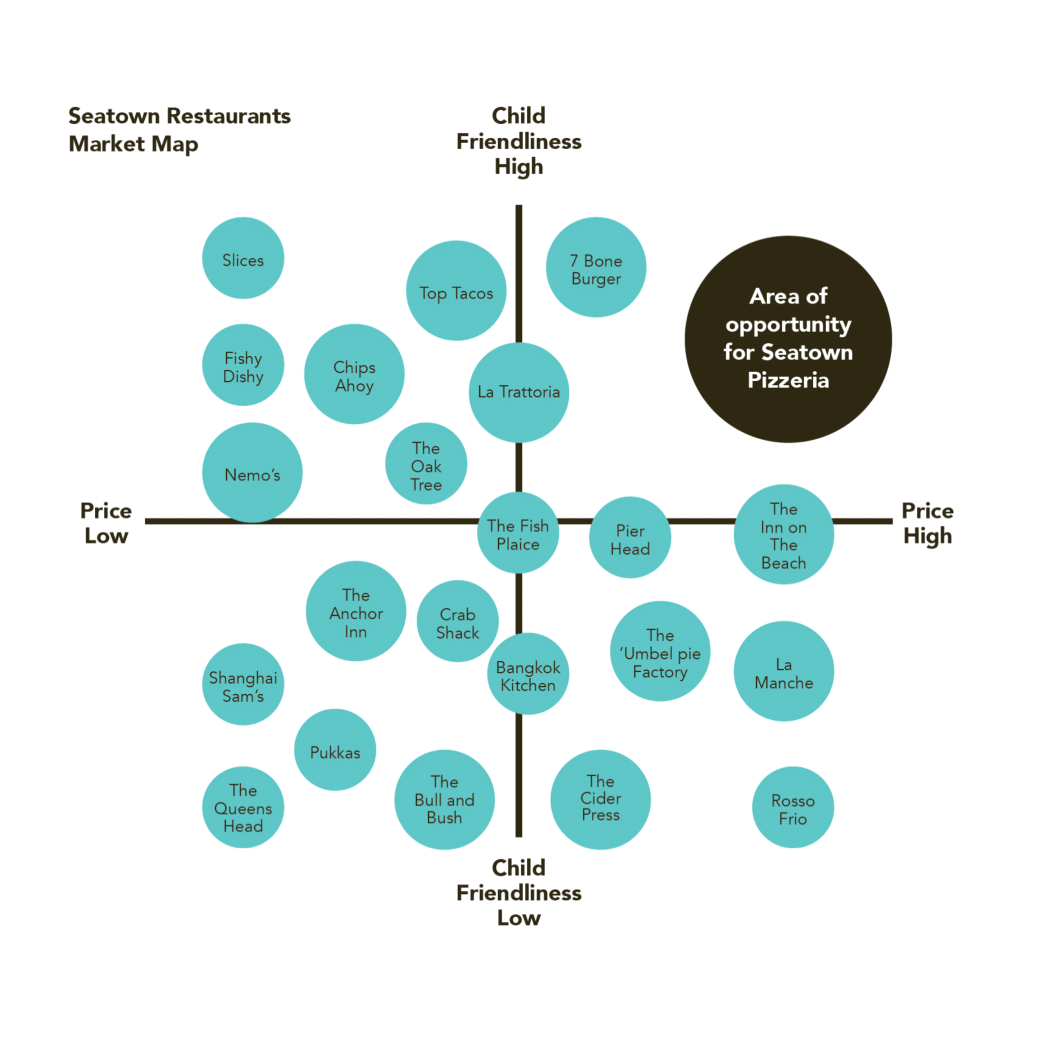
There may not be a lucky gap in your market but the map will define your closest competitors and may show you shifts you need to make, giving the organisation direction. But we are not finished quite yet….
4. What does your brand offer that is different or better?
So you know what market you are in, what drives your customers, where the opportunity lies within the market and who you will be fighting hardest for the customers’ choice. Now you need to give them a reason to choose you. Hopefully what you make or do will in some way relate to the category driver! If you are the best at fulfilling the main driver that is a great place to be. It may feel a bit generic, but don’t diss it … you can own the category and may already be the brand leader.
It is easy to get obsessed with uniqueness here. Almost no brands offer something that no one else does and these days things can be copied in no time. It’s fine to find an aspect of your offering that’s better than most (or just very good) that gives you the “right to win” with your customers. Adding separately the thing that makes you different can bring the uniqueness.
Our fictitious Pizza restaurant’s right to win could be the joy of having everyone in the family eat just what they want to eat.
5. Why is this true?
Empty promises generally go down badly with customers (strangely obvious if you think of them as human beings). Your brand positioning should hold everyone to account for doing what you say you will do and must include this “reason to believe”. Write it all down and sock it to the organisation. Here’s one of my favourites, researched and interpreted:
IKEA
For everyone to whom their home matters, IKEA is a manufacturer and retailer of home furnishing products which democratise a better everyday life by offering a wide range of well-designed, functional products at prices so low that as many people as possible will be able to afford them.
And one for our fictional Pizzeria:
For those in Seatown on their family holiday and hoping for times of joyful togetherness, Pizza United is a restaurant devoted to creating occasions where everyone gets their favourite meal by making great quality pizzas with customisable toppings and involving the kids in making them.

And lastly, don’t make positioning the preserve and prerogative of marketing
Daryl Fielding
So now it's coherent, clear, true, short, memorable. Every employee should be able to remember it and use it to drive decisions. Please only change it if big external factors make change absolutely necessary. But it must be owned by the Board down and socialised across the whole organisation. Marketing might start and lead the creation of the brand positioning, but it is too strategic and fundamental for it to end there.
Authored by Daryl Fielding, Portfolio Board Director, NED, Trustee, Author