
The story of Sony's PlayStation did not begin in a boardroom strategy session. It began with a young engineer watching his daughter play. Ken Kutaragi saw his child tinkering with a Nintendo Famicom and noticed something others had missed. He worked in a hierarchical organisation where colleagues told him to go back and do his own job, yet he became what Thomas Barta calls a “Growth Rebel”: someone who ignites an idea and rallies an organisation to make it happen, even in the face of fierce resistance.
Today the PlayStation is Sony's most important product and its biggest revenue driver. It did not come from a chief executive's strategy document, an offsite or a consulting engagement. It came from one person who ignored what he was told and pushed his vision forward anyway.
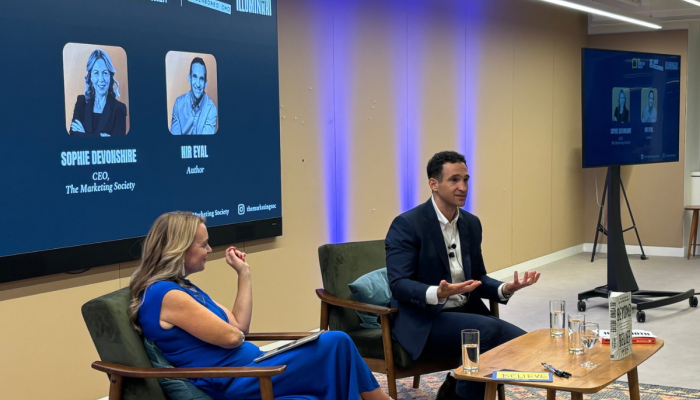
In a recent The Marketing Society LinkedIn Live, I sat down with Thomas Barta to explore why that kind of marketer matters more than ever, and what the rest of us can learn from them.
The growth crisis hiding in plain sight
Kutaragi's story is inspiring, but it points to a deeper problem in modern business. The Global Fortune 500 grew by just 0.1% in 2023, barely above a rounding error, and even the modest recovery to 1.8% in 2024 shows how hard companies are finding it to grow while the world around them accelerates.
We are living through a period that Bain scores as the most turbulent on its “turbulence index” since the years between the American Civil War and the Great Depression. Covid grounded entire economies in twelve weeks, faster than many companies can issue a purchase order. Yet corporate growth has stalled.
The cause is not a shortage of good ideas or clever people. Thomas identifies the real culprit as an increasingly clogged innovation funnel. The path from idea to execution now meets more resistance than ever, as policies, compliance, legal hurdles and data paralysis slow everything to a crawl. Coca-Cola Spiced is a neat example. Skilled marketers, armed with solid data and proven playbooks, still saw the product pulled from shelves within months, because they became so absorbed in big data and agile process that they forgot to actually talk to their customers.
The anatomy of a growth rebel
Thomas's research with more than 3,000 people across 160 countries shows that business impact comes from two skills in almost equal measure: 55% from growth skills, the ability to ignite ideas, and 45% from mobilising skills, the ability to rally an organisation. Those two dimensions create four types of people in every business.
Cogs go along with what they are told. They keep the machine running but do not drive growth beyond what the plan says. Ninjas execute their boss's vision well, which makes them popular, but they rarely bring new thinking. Dreamers arrive every day with wonderful ideas that never quite materialise. And then there are Growth Rebels, who sit in the sweet spot where igniting ideas meets organisational mobilisation. These are the people who do not simply have good ideas, they make them happen in spite of institutional resistance.
The real growth map
Most marketers fixate on market share, yet Thomas's data suggests it accounts for only about 20% of growth. The larger share, somewhere between 40 and 60%, comes from improving the core business through new customers, segments and offerings, and a further 20 to 40% comes from building entirely new core businesses.
Growth Rebels understand this and cast a wide net. Rather than hunting for a single perfect idea, they explore a hundred possibilities across what Thomas calls the “world map of growth”. That map takes in granularity (a product that stalls in London might thrive in Edinburgh), convenience (younger consumers who own no can opener are exactly why tinned tuna now arrives through delivery apps), past successes (the enduring pull of Adidas retro designs) and the largest global trends.
Those trends are striking. Up to 700 million new Asian consumers are expected to enter the market by 2030. Some 2.5 billion more people will live in cities by 2050. The over-60 population is set to double. The energy transition alone represents $2.1 trillion of investment, making it the largest industry in the world. Too many marketers remain fixed on incremental share when opportunities of this scale are in plain view.
We are also witnessing the biggest shift in business for a generation, from what Thomas calls the “selling economy” to the “relationship economy”. The selling economy rewarded the “Purple Cow”, the product so distinctive it stood apart from every competitor. Today, technology lets companies build real-time relationships with customers at scale. L'Oréal, which historically never sold directly to consumers, now creates personalised shampoos with each customer's name on the bottle. For Growth Rebels who grasp it, this shift is an enormous opportunity, because the future belongs to those who can build real connection rather than simply push product.
The art of organisational mobilisation
Great ideas count for nothing without the ability to rally people behind them. Yukiko Yamaguchi, Chief Marketing Officer of Panasonic Connect, shows how it is done. She entered a male-dominated, B2B engineering culture where nobody wanted marketing, and she could have taken the resistance on directly. Instead she used what Thomas calls “soft power”.
Her breakthrough came from a simple proposition: let's run some customer interviews together and see what customers actually say. It took time to find even one willing department, the mobile computer division, but once they had run the interviews and learned something valuable, the practice spread quickly. She now leads one of the largest marketing transformations in the world, and Panasonic Connect is thriving.
This captures something important about Growth Rebels. They find their allies among the hungry, the angry and the idealistic, the people Thomas calls the “unusual suspects”. They also make clever use of data, because, as he puts it, the chief financial officer holds very interesting data, and that is precisely why everyone wants to talk to them. When you consistently bring insight that others cannot ignore, you build momentum.
The failure paradox
Perhaps the most honest note in the conversation concerned the mythology of “failing fast”. Chief executives love to say they want innovation and rapid failure, but the reality is blunter: companies reward success, not failure. If you fail, that is on you.
Growth Rebels have to accept this as an occupational hazard. The system will never fully back the risk-taking that drives breakthrough growth. The PlayStation succeeded in spite of Sony's initial resistance, not because of institutional support. Growth Rebels learn to live with that reality and keep pushing anyway.
Three Key Takeaways
One
Resistance is intensifying, but it can be overcome. The innovation funnel faces more obstacles than ever, and Growth Rebels navigate them by finding allies and using soft power.Two
The real growth lies in the unexplored 80% beyond market share. While most marketers compete over incremental share, the opportunity sits in improving the core business and building new ones, across global trends and demographic shifts.Three
Effective marketers are Growth Rebels. They move beyond being Implementers, Dreamers and Flow Keepers, and they learn the skills to drive real growth and take measured risks.Two Essential Actions
-
Map your hundred growth ideas systematically. Do not settle for a handful of obvious options in a brainstorm. Explore granularity across segments and geographies, look for convenience, revisit what has worked before, and track the major global trends such as urbanisation and demographic change.
-
Then find and cultivate your rebel network. Seek out the hungry, the angry and the idealistic, your own unusual suspects, and build your soft power through compelling data, customer insight and the small wins that create momentum for bigger change.
The line that stays with you
As Thomas put it, with characteristic clarity:

"People will not remember you for good work. People will remember you for outstanding work."
In a world where corporate growth has stalled while change accelerates, the choice is clear. You can be a Flow Keeper who maintains the status quo, an Implementer who delivers someone else's vision, or a Dreamer whose ideas go nowhere. Or you can become a Growth Rebel, someone who ignites breakthrough ideas and rallies an organisation to make them real, in spite of the resistance, the politics and the risk.
The PlayStation exists because one person refused to accept no for an answer. In today's turbulent environment, every organisation needs more people willing to do the same.
This piece was written by Rachel Letham, Global Head of Marketing and Brand at The Marketing Society, drawing on AI to distil a recent LinkedIn Live conversation with Thomas Barta.
Find out more about The Marketing Leadership Masterclass led by Thomas Barta and Syl Saller - The Marketing Society Members get a special rate.