When I was dean of the Brand Marketers Academy at Cannes this year, one of our speakers was a cardiothoracic surgeon, JaBaris Swain. He wasn't there to talk about hearts. He was there to talk about creativity in the operating theatre - planning, prep, brand codes, the frame you build so you can actually be creative inside it. "Constraint is the canvas," he said. And this one has stayed with me since: "We don't plan to fail; we plan so failure doesn't get to improvise."
It struck me that some of the best thinking on marketing right now isn't coming from marketing at all. Surgery is one discipline worth borrowing from. Physics, for me, has been another.
I spend a lot of time thinking about customer journeys - funnels, loops, spirals, whatever shape we're drawing on the whiteboard this quarter. And I keep coming back to two forces that explain almost everything about whether a customer moves, or stays put. Friction. And gravity.
Friction is the tax on every step
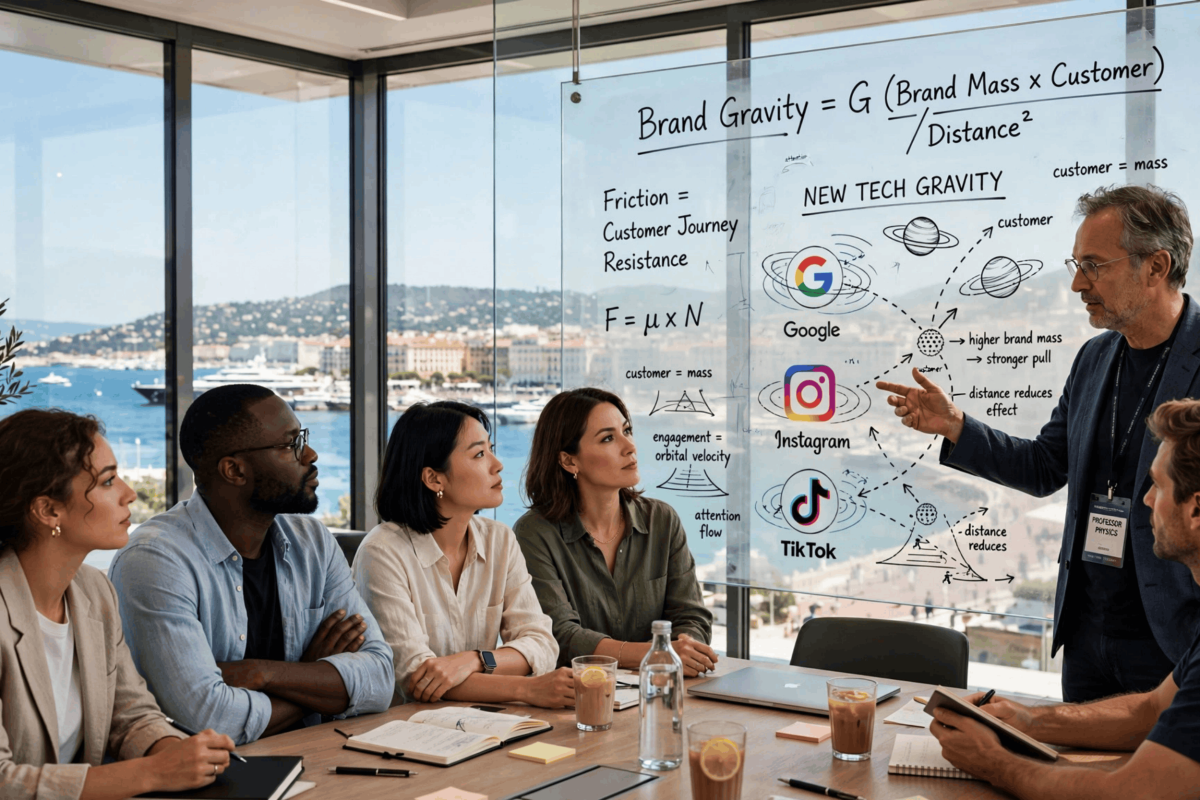
Physics has a simple formula for this: the force needed to overcome friction is how rough the two surfaces are, multiplied by how hard they're pressed together.
Translate that and the roughness is the process itself - how many logins, how many mismatched screens, how many steps that don't need to exist. The pressure is the weight of the decision. A subscription renewal barely registers. A mortgage carries a lot. So a small amount of roughness can kill a low-consideration purchase stone dead, while a high-consideration one will push through far more friction to get there. Kotler's foundational idea was that marketing exists to facilitate exchange - every barrier under access, convenience, and information is that same roughness and weight, wearing a different name.
In practice, that's how hard it is to find information, whether it's consistent across your website, store, and app, and how many clicks stand between "I want this" and "I have this." Every extra step bleeds people out of the journey.

"Nobody wins an award for cutting a checkout flow from five steps to three. But friction compounds, and reducing it is often the highest-leverage work a marketer can do."
Lex Bradshaw-Zanger
Gravity is what pulls you back
Friction alone doesn't explain behaviour, though. If it did, the easiest option would always win. It doesn't. Newton's version of gravity works on three things: how much mass each object has, and how far apart they are. More mass means a stronger pull. More distance means a weaker one, and it weakens fast. Translate that and one side is the mass of the brand, the other the mass of the need in a customer's mind. Distance is how many touchpoints stand between where they are and where you are. Grow the mass, or shrink the distance, and the pull increases, the whole logic behind distinctive assets and category entry points.
Gravity has two forms:
Physical gravity is availability: the product being where you already are, the refill that shows up, the app already on your phone. This is Byron Sharp and Ehrenberg-Bass territory: physical availability is the mass of the brand, and the bigger it is, the less convincing you need to do.
Mental gravity is the emotional version: how much space you occupy in someone's head, and how easily you're retrieved. This is where Binet and Field's long-and-short-of-it earns its keep. Short-term activation shrinks the distance to purchase for demand that already exists. Long-term brand building grows the brand's mass so the pull persists regardless of distance on any given day.
Two forces, two jobs
Reducing friction is an activation job, short-term and tactical. Building gravity is a brand job, long-term and cumulative. Most organisations reward the first and neglect the second, because friction shows up in a dashboard and gravity shows up in a P&L three years from now. Mark Ritson has built a career on this point - marketers conflating activation with brand building, rewarding whichever is easiest to measure this quarter, when they're really two parts of one equation.
A brand with huge mental gravity and terrible friction still loses the sale at the last click. A brand with zero friction and no gravity is just the cheapest, most forgettable option in the category.
Where this is heading
Media and commerce have both been through the same cycle - fragmentation, then consolidation into a handful of apps and platforms with real gravity of their own. Now both are being pulled toward a new centre: search as a conversation with an LLM rather than a list of links. That's a gravity problem with a new kind of mass - how consistent a brand is across the internet, how consolidated the information about it is, how often it surfaces in these conversations. A brand with real gravity has a better chance of being pulled into the answer.
Which means gravity now lives inside the experience itself, not just the message. Every interaction, the app, the checkout, the unboxing, is another place your cues either show up, or don't. When that experience is also frictionless, it stops being two jobs. A joyful, effortless experience builds the brand at the exact moment it moves someone toward purchase.
The conclusion physics already gave us
Newton's first law says an object stays in motion, or at rest, unless a force acts on it. Left alone, a customer doesn't move toward you. His second law, force equals mass times acceleration, gives us the rest: the pull toward your brand comes from your mass, acting over whatever distance still separates you, working against the friction generated by how rough the process is.
Grow the mass, and you need less force to close the sale. Remove the friction, and the mass you already have converts into motion faster. That's the whole job - not chasing a single campaign, but managing the net force.
Where's the net force weakest in your business right now - not enough mass, or too much drag?
Read Lex's full article on this subject here.
Ideas by Lex, writing assisted by Claude, visual supported by Meta AI