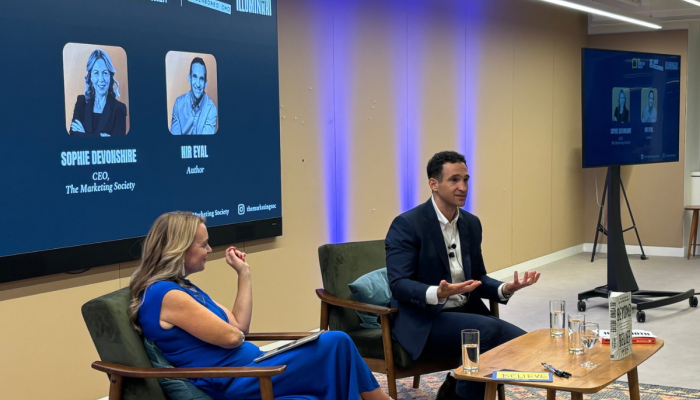

Artificial intelligence is reshaping how we work, create, and make decisions. In marketing, it already enables content at scale, real-time optimization, and increasingly precise personalization. But as adoption accelerates, there is a risk we overlook something fundamental.
The more intelligent our systems become, the more human our leadership has to be. This isn’t a philosophical statement, it’s purely commercial.
Human experience is the advantage
Access to information is no longer a differentiator - judgment is. And judgment is shaped by lived experience: how we interpret complexity, navigate uncertainty, and make decisions when there is no obvious answer.
I’ve been open about my fertility journey and experiencing miscarriage during my career. Not because it was easy, but because it was real. And what stayed with me wasn’t silence; it was openness. Being able to share creates space for others to do the same. My journey to having my child became, in many ways, a collective one.
That experience continues to shape how I lead. Because when people feel able to be honest, decisions improve. Ideas become stronger, and work becomes more relevant. AI can identify patterns but it cannot understand what those patterns mean in a human context.
In a world of infinite content, meaning matters more
We operate in an environment of constant content, optimization, and automation. Information is more abundant than ever, but attention is as scarce as it’s ever been. What creates (and will continue to create) connection is not volume, but relevance. Not just output but meaning. And meaning is built on context, emotion, and experience; in other words, things that cannot simply be generated at scale.
AI is becoming an intermediary
We still often talk about AI as a tool. Increasingly, it also acts as an intermediary, filtering information, shaping visibility, and influencing how brands are experienced. In many cases, brands are no longer speaking directly to people first. They are being interpreted by systems -that shift matters.
We are no longer only competing for attention; we are also competing for how we are interpreted. Optimizing systems (structure, patterns, predictability) can drive performance. But it can also reduce what makes brands distinctive. Because while AI may influence what is seen, people still decide what they trust, remember, and act on.
Brand starts from within
If connection externally is human, then brand cannot be built purely through campaigns. It is shaped by what leaders prioritize, what is safe to say, and which experiences are acknowledged, or overlooked. If people feel they need to edit themselves at work, it becomes difficult to create work that feels genuine externally. Authenticity is not something that can be engineered, it is a reflection of culture. And in a world where so much can be generated, that distinction matters more than ever.
The leadership shift
Leading in the age of AI requires more than adoption; it requires judgment.
Leading with judgement means:
Taking the time to question outputs, not just accept them
Balancing data with experience and perspective
Protecting long-term brand value alongside short-term performance
Because the risk is not that AI fails. It is that it works – efficiently – towards outcomes that lack meaning or distinctiveness.
The opportunity
AI gives us the ability to scale. But what we choose to scale matters. As AI becomes both a tool and an intermediary, the brands that succeed will not simply be the most optimised. They will be the ones that create genuine connection. They will be the ones that feel human.