RPM is an independent creative agency based in London. We connect brands in culture and commerce – creating meaning and shaping consumer and shopper behaviour, through experiences that close the gap between cultural demand and conversion.
Through research specialist, Canvas 8, RPM interviewed senior marketers from FMCG, hospitality, tech and entertainment sectors, to understand how effectively brand systems today are keeping pace with business operating models.
What you need to know
1. The biggest branding challenge today isn’t consistency, it’s adaptability
Across FMCG, hospitality, tech and entertainment, senior marketers consistently told us the issue isn’t that brand systems lack control. It’s that they lack flexibility in the places brands now need to operate most dynamically: retail, social, creator ecosystems and experiential.
Several respondents said their guidelines work best in traditional channels like TV and print, and less effectively in the environments which are increasingly seen as driving growth. This leads us on to our next point…
2. The channels driving modern growth are often the hardest to brand effectively
Social and retail channels were repeatedly cited as the most difficult channels to activate brand systems within. Not because teams don’t understand the brand, but because the mechanics of modern platforms and retail demand speed, relevance and cultural fluency that rigid systems struggle to support.
A marketer from a global FMCG business described the tension as:
“Channel-first creation vs. cut-and-paste ATL across channels.”
The implication is significant: many brand systems were designed for campaign distribution, not continuous participation or conversion channels.
3. Global consistency is increasingly colliding with local relevance
For international businesses, the challenge is no longer simply scaling assets globally, it’s enabling markets, partners and teams to adapt effectively without losing coherence.
Technology and hospitality brands in particular highlighted the growing tension between centralised governance and decentralised execution. One respondent described modern brands as “dynamic ecosystems” rather than linear communications systems.
This shift is changing what marketers need from branding systems altogether.
4. Brand systems are evolving from rulebooks into operating infrastructure
A consistent theme emerged across the research: marketers no longer want static PDF guidelines or overly-policed governance models.
Instead, they’re looking for:
- principle-led systems versus purely rigid rules
- codification of assets showing what to use when
- modular frameworks that flex by channel and context
- embedded tooling and automation
- systems that help teams move faster, not slower
Several respondents referenced the need to move from “brand police” to “brand coaches”, enabling judgement based on the objective, rather than guidance designed to restrict usage.
5. The future brand system is built around experience, not identity alone
Perhaps the clearest shift is that branding is no longer viewed purely as a communications exercise. Increasingly, marketers see brand as something experienced through retail environments, ecommerce journeys, customer service, partnerships, communities and product interaction.
That changes the role of the brand system itself.
The strongest systems of the future are unlikely to be the most rigid or comprehensive. They’ll be the ones capable of creating coherence across complex, fast-moving and culturally fluid ecosystems.
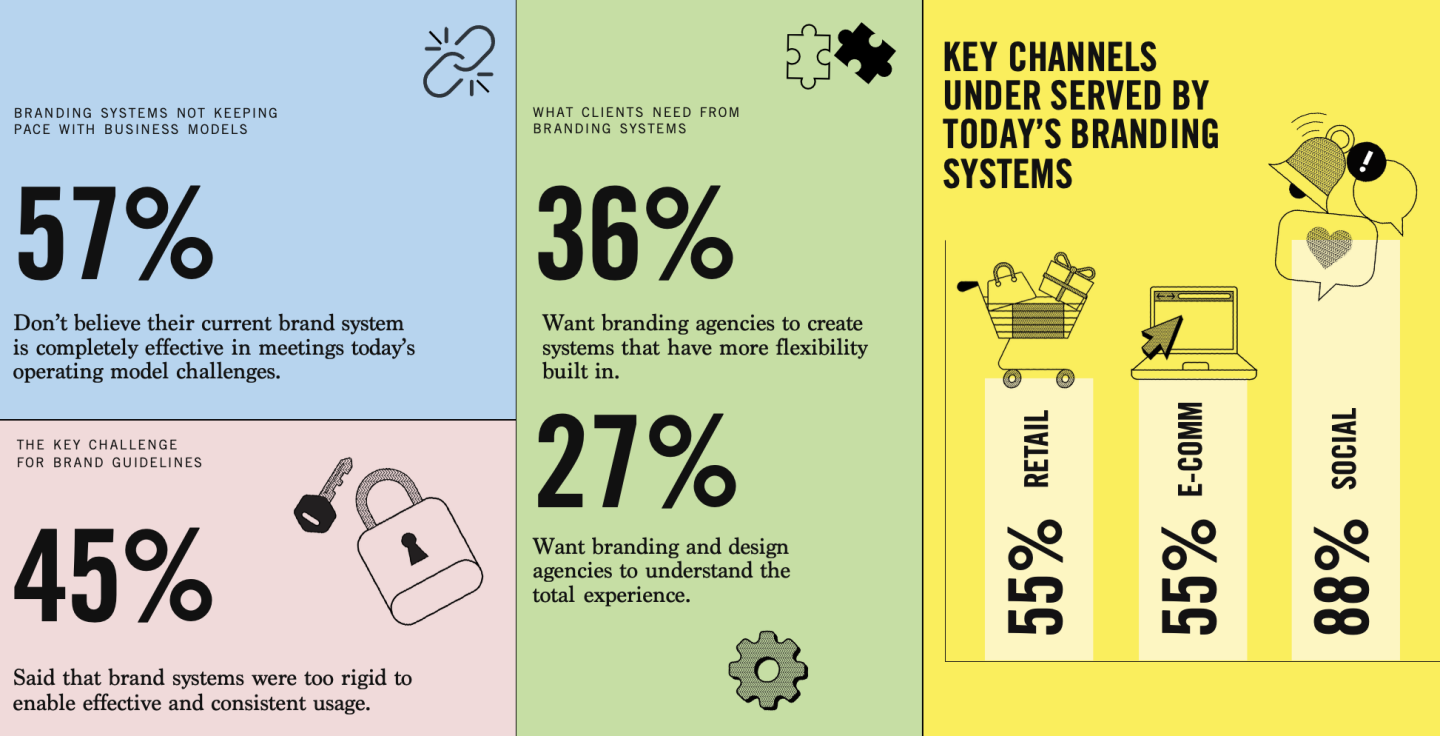
57% Branding systems not keeping pace with business models
45% Brand systems too rigid to be effective
27% want agencies to understand the total experience
3 Takeaways
Modern brand challenges are operational as much as creative
Consistency alone is no longer enough; adaptability has become a strategic requirement
The most effective brand systems enable participation across channels, markets and moments, not just compliance
“Brand and business operating models are more complex because brands today must be faster, more flexible, more compliant, and more consumer-centric all at once. Success increasingly depends on adaptive, cross-functional, and scalable operating models rather than static structures.”
Canvas8 survey respondent within FMCG
2 ACTIONS
Marketing leaders should consider
Audit where your current brand system breaks down
Particularly across social, retail, experiential and partnerships, the channels most respondents identified as under-supported.Define what should stay fixed vs. what should flex
Future-fit systems are increasingly built around clear principles and adaptable frameworks, rather than exhaustive rules.