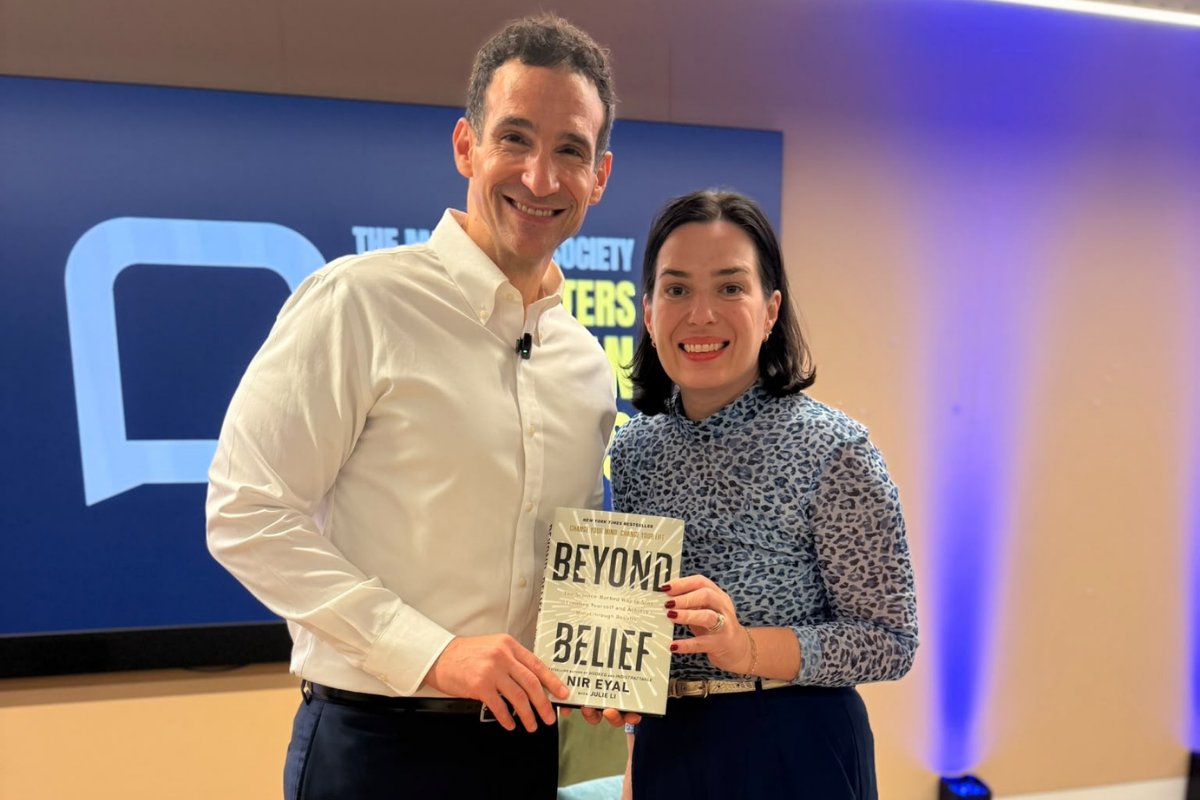
We know what we should do. So why don't we do it? On 29 September, Nir Eyal joined Sophie Devonshire to explore that question and the ideas in his new book, Beyond Belief. The conversation looked at why people believe what they believe, how those beliefs can change, and what this means for us personally, professionally and for our brands. Abigail Dixon reflects on the evening and what she took from it.
What are beliefs?
Beliefs aren't facts. They're subjective views we've repeated so often that they feel like fact, which means they can change. The evening's conversation began by focusing on limiting beliefs: the beliefs that stop us from making change and achieving what we want.
Knowledge isn't enough
Nir opened with the point that we're drowning in knowledge, yet knowledge alone doesn't change behaviour. We know what we should do and still don't do it, because there's no straight line between behaviour and benefit. To make sustainable, long-term change, we must believe the benefit will come. We also must believe in our own ability to do the thing.
Once that belief is in place, persistence becomes the number one trait in whether we deliver on a goal. It matters more than knowledge or opportunity. The personal research I have done in what it takes to enable change also highlights the importance of being emotively attached to the outcome to drive motivation and have the support of peers around us.
Doing the work
I often tell the marketers I work with to "do the work". Having set our goals, edging closer to our goals brings fulfilment, even better when they're aligned to our value, but they can also take us outside our comfort zone. That is when limiting beliefs can come flooding in. Doing the work means noticing those beliefs, reframing them and continuing to move towards the goals that matter.
What resonated most for me was the name Nir gives to the beliefs reframing can lead us to: liberating beliefs. These are the beliefs that increase motivation and reduce suffering. The term captures what's possible when you put in the work to change your thinking. It starts with identifying the limiting belief. We can see everyone else's limiting beliefs but not our own, just as we can't see our own face. We need a mirror. Many of us can name ours easily: "I don't have enough time/energy/ability to…"
What are yours that you are carrying? What I loved is that Nir gives equal weight to the liberating beliefs we could hold instead. Getting from one to the other starts with reflection.
Reframing in action
Nir showed this live with Kerry Collinge, who shared a limiting belief she'd been carrying. He took her through a set of questions from Byron Katie's The Work, and she began to loosen her hold on the belief:
- Is it true?
- Can I absolutely know that it's true?
- What happens when I believe that thought?
- Who would I be without the thought?
- What happens when I turn it around? Could the opposite be just as true?
That last question is the most powerful. Holding on to limiting beliefs makes us suffer and can stop us from doing the thing we've always wanted to do, which can result in regret. Turning them around shows that the opposite can be just as true. Often, what we believe is a misattribution of emotion: we blame something outside us for what we feel inside.
Flipping the belief for brands
The same thinking applies to brands. Nir shared Liquid Death as a case study. It disrupted the water category by standing for the opposite of the category belief that water is all about purity and life, it challenged what consumers and customers believed about the product and category, and ultimately, their behaviour.
Turning it around for marketing
I truly and passionately believe marketing should be leading and driving the long-term commercial agenda for brands and businesses. Sophie finished by asking the community a powerful question: how do we change the beliefs others hold about marketing?
So, here's my question to you: what's the one belief about marketing you'd turn around first?