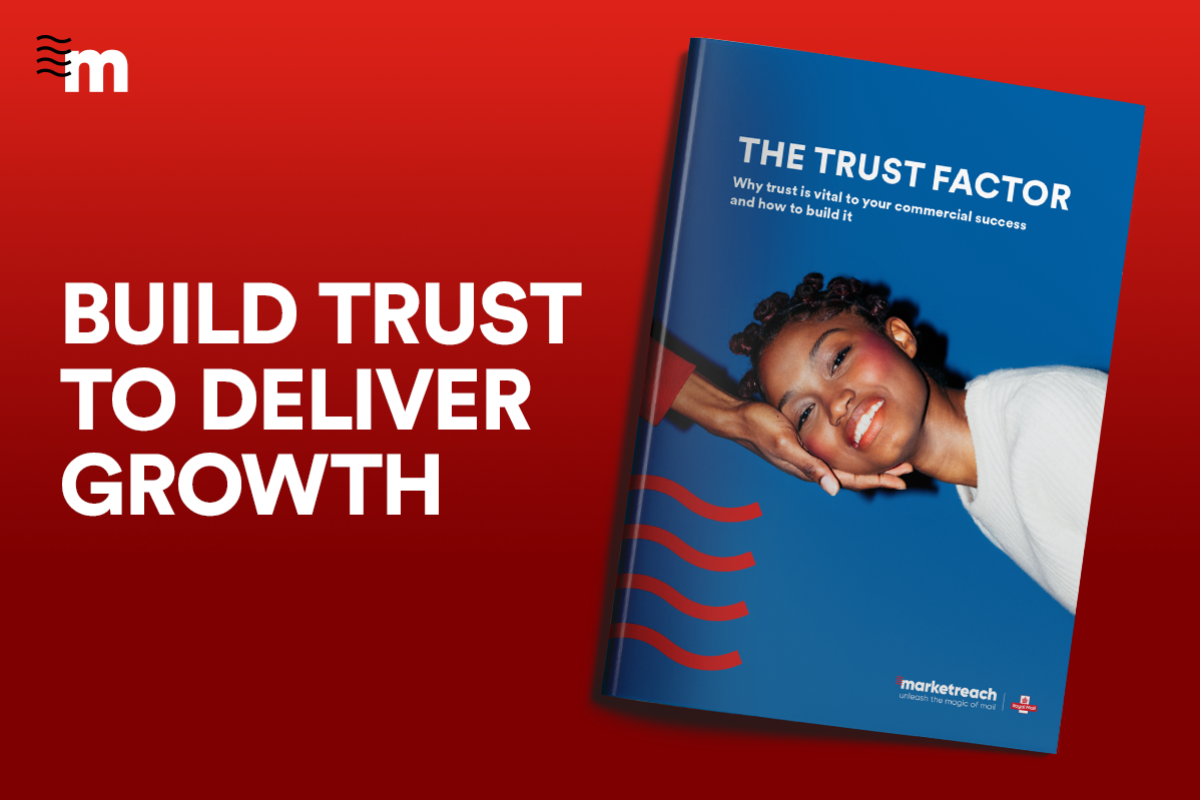
Trust has always been important in business but surprisingly little research has been done on its value and impact between brands and their customers. A new ground breaking report by Marketreach, The Trust Factor, changes that, revealing why trust matters commercially, how it's built and what happens when it's lost.
The findings are clear: trust isn't just a nice-to-have quality, it's a measurable driver of commercial success that directly impacts the bottom line.
Involving a programme of nationally representative qualitative and quantitative studies, using Structural Equation Modelling to analyse the attributes of trust and conjoint analysis, the research revealed five fundamental discoveries that frame how we should think about building and maintaining trust.
5 Key Points from the Report
Trust is made up of eight distinct pillars
Trust is composed of eight interconnected pillars, each with a specific role. Reliability is the heavyweight 35% of trust, followed by Reciprocity at 19% and Aligned Interests at 14%. The remaining pillars are Stake (9%), Familiarity (9%), Fame (5%), Frequency of Communication (2%), and Tenure (1%). Each pillar requires different strategies to build and maintain. Reliability comes from consistently meeting promises and expectations over time. Reciprocity means rewarding trust by making customers feel trusted by you, while Aligned Interests shows you have their best interests (not just money) at heart.Trust directly drives 13% of consideration
After value for money, trust is the most important factor in brand relationships. When people trust a brand, 92% will take some action and 74% will act in a commercially impactful way. It’s the difference between a brand people scroll past and one they actually buy from. Next, using Structural Equation Modelling, researchers found exactly how much brand consideration comes from trust: 13%, making it the largest, single influencing factor for consumers.Different sectors rely on different pillars
Understanding which pillars matter most for your organisation is key. For commercial organisations (including banks and retailers) Familiarity, Frequency of Communication and Tenure matter more, public institutions (HMRC and the DVLA) depend heavily on Reliability and Reciprocity; charities need Reliability, Reciprocity, Aligned Interests and Stake and the NHS, Britain's most trusted institution at 80% trust, succeeds fundamentally on Reliability and Aligned Interests.The Communications Formula reveals how to influence brand trust
Made up of three components: the messenger (who is speaking), the medium (the channel used) and the message (what's being said), the report also revealed their relative importance in communicating trust: Messenger at 50%, Medium for 42%, and Message 8%. Far from meaning that Message is unimportant, this formula confirms what Marketers have always known, a great ad can’t fix a bad brand. Only starting with a strong brand and choosing the right channel ensures your message reaches the right audience in the right way. The degree to which an audience trusts what you say depends how much your brand is trusted and how much the channel you're using is the best choice for the message being delivered.Direct mail is the most trusted communications channel
At 54% trust, direct mail (DM) outperforms every other channel including TV adverts (51%), emails (49%), press (48%), radio (46%) and social (35%). Consumers can engage with DM on their own terms without pressure, it feels safe because verifying the sender is easy and is less vulnerable to fraud but most importantly, 55% of people actually like receiving mail, compared to 60% who find social media messages intrusive.Beyond these specific discoveries, three broader principles emerged that translate directly into strategic advantage. These takeaways represent the practical realities that every marketer must grapple with when building trust in today's complex commercial landscape.
The 3 Take-aways
Experience drives everything
When expectations are met repeatedly, confidence grows and trust follows. Poor experience is the number one reason people stop trusting organisations, cited by 37% of former customers. Poor value for money and poor product quality each score 30%. Trust disappears when there's a gap between personal experience and expectations, creating the Trust Deficit. Organisations operating without trust spend more time and money than their competitors to achieve comparable results.Lost trust can be rebuilt
Happily, trust can be restored or even rebuilt, higher and stronger by repairing whichever of the pillars have been damaged and dealing with problems efficiently and effectively. It requires organisations to acknowledge mistakes and use plain language to rebuild. While losing trust is expensive, the long-term gain from repairing it will exceed the investment required.Integration amplifies trust
Integration ensures your message benefits from the extra power that comes from trusted channels. DM, the most trusted channel, plays a specific role in building Reliability, Fame and Familiarity, which together feed into trust. Only email joins DM in having a direct effect on consideration. This doesn't mean abandoning other channels, it means understanding that each channel contributes differently to trust. Combining the right messenger, the right medium and the right message builds trust systematically across all eight pillars.Understanding the mechanics of trust provides strategic insight, but insight without action is merely interesting rather than useful. Here are two concrete steps you can implement immediately to begin building stronger trust with your customers and prospects.
2 Action Items
Audit your eight pillars
Assess your current standing on each of the eight pillars of trust. Remember that different sectors weight pillars differently, so compare yourself to appropriate benchmarks. For commercial organisations, focus on Reliability, Reciprocity and Aligned Interests, while ensuring Familiarity, Frequency of Communication and Tenure are not neglected. For public institutions, Reliability and Reciprocity matter most. For charities, add Aligned Interests and Stake to those two. Once you've identified your weakest pillars, develop strategies to strengthen them.Integrate direct mail into your communications strategy
Given that DM is the most trusted channel, evaluate how you use it. Leverage its unique strengths around security, tangibility and personalisation, and use it to build the specific pillars where it excels: Reliability, Fame, and Familiarity. Consider how it works alongside your other channels to create a communications mix that maximizes trust. Remember the Communications Formula: if your brand is strong and you choose a trusted medium, your message can shine through when competing brands struggle. It’s not about abandoning digital channels, it's about understanding that 53% of people feel direct mail is more secure, 59% find it more informative and 55% like receiving it.Throughout the research, multiple voices contributed insights about trust's commercial value but perhaps no single statement captures the real-world cost of operating without trust more clearly than this frank admission from a marketing leader working in a sector where trust is particularly hard-won.
"There's lots of research that says if your organisation is not trusted that comes at a cost. One of those costs is to acquire a new customer and we have to discount purely because we're not a trusted brand. Even though we have more integrity, we're more reliable than all of our big competitors, we're paying a price."
Marketing Director, utilities sector
This quote reveals the Trust Deficit in stark commercial terms. Untrusted brands pay more to acquire customers, often through discounting, even when they actually deliver better service or products. Trust isn't just about reputation or brand health scores, it's about whether you can command fair prices, retain customers efficiently and compete without constant promotional spending. The report proves that trust is foundational to business success, it quantifies exactly how it works and provides the tools to measure and build it systematically. That's not just valuable information, it's a competitive advantage waiting to be claimed.
Marketreach are partners of The Marketing Society. You can read the full report here.