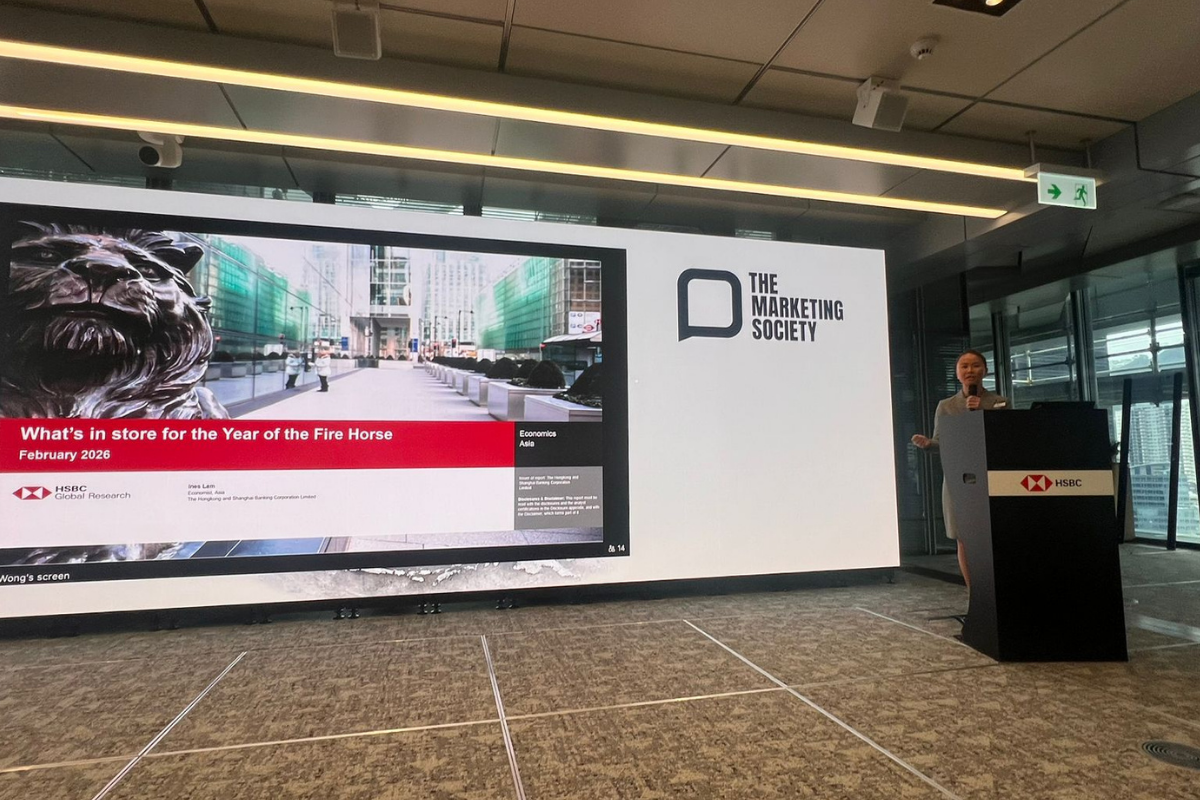
It was a pleasure to speak to members of The Marketing Society Hong Kong again. In the brief period since June 2025, both geopolitics and the global economy have undergone notable changes. To set the scene for my presentation, I began with a short quiz on key events in 2025, which the audience aced.
The year 2025 was marked by considerable uncertainty. As a case in point - two weeks after the presentation, the US tariff landscape changed substantially. The Supreme Court, in a 6–3 decision, declared most of President Trump’s tariffs unlawful, restricting the administration’s ability to impose tariffs unilaterally. Despite this, the president indicated plans to pursue further trade measures, including a global tariff initially set at 10%, then raised to 15% the following day. The ruling injects fresh uncertainty into global trade policy: firms now face legal and political whiplash, with policy reversals and new measures possible in short order. Businesses must be prepared to adapt rapidly to shifting rules and heightened instability in trade governance.
AI: Growth Engine or Market Bubble?
Additional sources of uncertainty are emerging. The global AI investment boom, primarily centred in the US, has driven growth in both US and select Asian economies. However, vulnerabilities are becoming apparent. Since the start of 2026, financial markets have shown increased scepticism regarding the sustainability of the AI surge, with AI-related equities experiencing volatility as investors reassess growth and profitability expectations.
AI will remain a dominant theme in capital markets and society throughout 2026 and beyond, first and foremost driving significant evolution in the workforce. While much attention is given to potential job losses from automation and AI, the real challenge is supporting individuals to adapt and thrive in roles that require uniquely human skills.
Workforce Transformation and the Rise of the New-Collar Era
At the World Economic Forum in January, Dan Shapero, Chief Operating Officer of LinkedIn, highlighted that the labour market is shifting towards a new era shaped by AI investment. Data shows that, although AI is impacting certain jobs, it is also generating substantial new demand—such as over 600,000 AI-enabled data centre roles and 1.3 million positions including AI Engineers, Forward-Deployed Engineers, and Data Annotators. Notably, AI Engineer has been one of the fastest-growing jobs on LinkedIn over the past three years, reflecting strong demand for AI-focused roles. This evolving landscape signals the rise of the "new-collar" workforce, a class of skilled professionals who blend technical know-how with practical, hands-on experience. AI is fundamentally reshaping both job creation and career choices.
China’s External Strength, Domestic Weakness
Beyond AI, China remains a significant force shaping the Hong Kong economy. In 2025, China demonstrated a unique dynamic: exports surged and the trade surplus hit a record high, even as domestic consumption stayed subdued. This imbalance - strong external demand alongside underperforming internal demand - has led Chinese firms to rely more heavily on foreign markets. With large, accumulated export earnings and limited lucrative domestic investment opportunities, Chinese corporates are rapidly investing abroad, building supply chains and deploying capital internationally. This shift has important implications for Hong Kong. Historically the city channelled foreign capital into mainland China; increasingly it is the conduit for Chinese capital going out to the world. That reorientation alters service demand across banking, asset management and corporate advisory, creating new revenue opportunities and requiring expanded cross-border capabilities. For marketing executives, the near-term environment is one of elevated uncertainty and ongoing structural changes. Most importantly, businesses must foster organisational agility, as rapid legal and policy shifts are likely. Those who adapt swiftly will be best positioned to seize the opportunities that 2026 may bring. I wish everyone a successful start to the Year of the Fire Horse.