
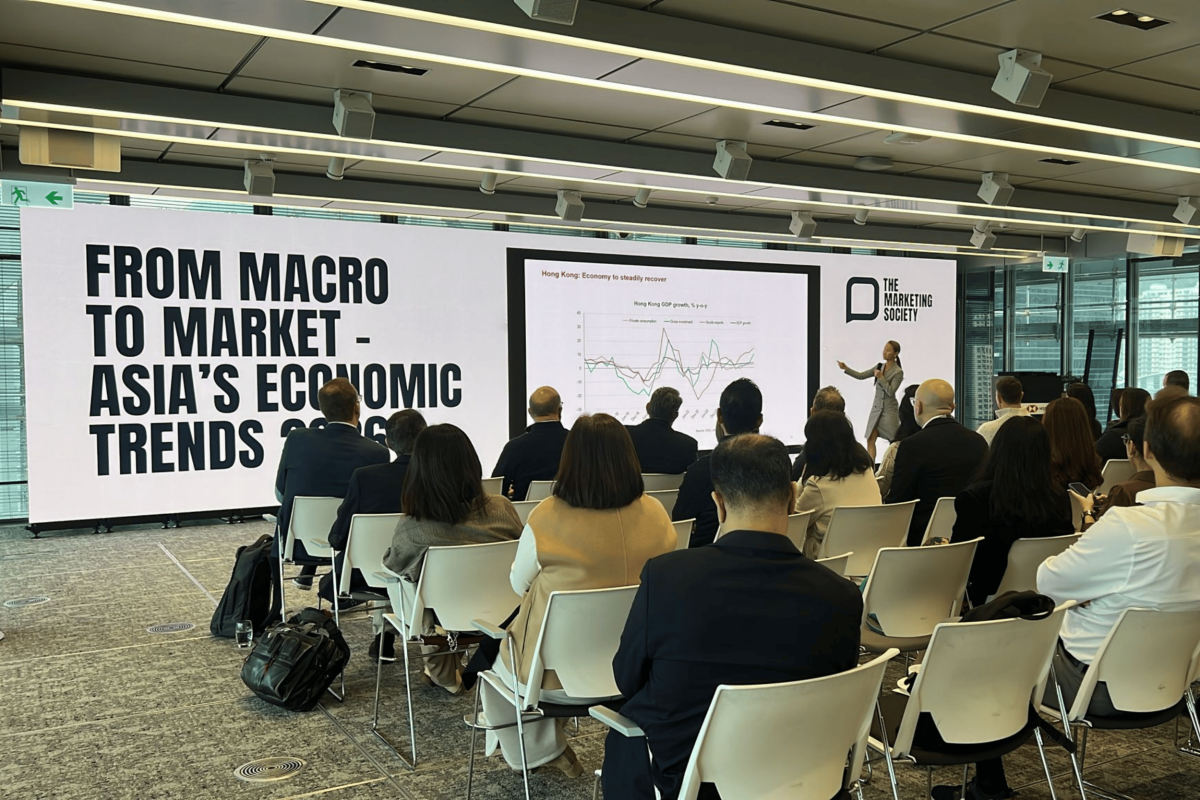
Asia’s economic story in 2026 isn’t about slowing down, rather a shift in where growth is coming from. Drawing on insights from HSBC’s Ines Lam, this piece explores how geopolitics, AI, trade fragmentation and capital flows are reshaping Asia’s growth model. The key message for marketers is that we have to look beyond the traditional assumptions around demand, influence and growth to survive in the new world order.
1. The US Still Drives the World, But It’s Losing the Plot
Volatility Is the New American Export
Lam didn’t sugarcoat it: the US still shapes global markets, but the relationship is rapidly changing. The US economy is being held up by AI-driven investment, while jobs, consumer confidence, and spending power is wobbling. The result is a classic K-shaped economy: winners at the top, pressure at the bottom. The knock-on effect is a sharp drop in trust with the US dollar falling nearly 10% last year.
There is a clear loss in confidence that the US is a safe haven. For Asia, this matters less as a dependency issue and more as an opportunity. If the world is looking for alternatives, Asia is increasingly showing that it’s ready to step up, adapt, and supply them.
2. AI Is Fueling Asia’s Exports, But Is It a Bubble?
Supply Is Exploding. Demand Is the Big Question.
The biggest growth engine in the US right now is AI investment, and Asia is one of its biggest beneficiaries. Hyperscalers are pouring money into advanced chips and hardware, and Asian economies such as Taiwan, Korea and Southeast Asia are seeing that demand in their export figures.
But Lam warns that the AI boom is not guaranteed: “We are seeing a huge increase in supply of AI. But will demand catch up? Will applications in companies or among consumers catch up? I think that will determine whether we can call it a bubble or not.”
For marketers, the message is clear: AI isn’t a “nice-to-have” headline, it has to deliver real customer value, otherwise the excitement will fade fast.
3. Tariffs Didn’t Break Asia, They Rewired It
The US Is Buying Less, but Asia Is Selling More
China’s exports to the US may have collapsed from where they once were, but they are still exporting to other major destinations such as Europe, ASEAN, Africa and Latin America. This isn’t a short-term pivot, it’s a structural shift with the US now barely accounting for 10% of China’s total exports.
With this shift, the supply chain is also evolving with manufacturing pivoting to ASEAN, but with China holding the reins as the central supplier of its inputs, machinery and components. Tariffs haven’t destroyed Asia’s trade, instead they’ve just forced a rebalancing for long-term growth.
4. China’s Real Problem Isn’t Exports, It’s Demand at Home
Savings Are High, but Confidence Looks Bleak
With China’s export story on the rise, the domestic economy is struggling with weak consumption, and fixed asset investment has contracted for the first time in decades. Confidence remains fragile, and it shows with consumers saving rather than spending.
That means Chinese companies are looking outward for growth. With fewer opportunities at home, they are investing overseas at pace by buying brands, building factories and expanding globally. Lam compared this to Japan’s overseas investment boom in the 1980s and 1990s.
For marketers, this is huge as Chinese capital is no longer just building inside China, it’s building global brand influence.
5. Hong Kong Still Has a Role, But It’s Flipped
From Gateway In to Gateway Out
Hong Kong has shifted from being a gateway for foreign capital into China to becoming a gateway for Chinese capital going out into the world. Banking flows show money moving from China through Hong Kong into ASEAN, the Middle East and Latin America.
This has revived Hong Kong’s IPO market and improved asset prices, even as local consumption remains weak. The future is less about filling shopping malls with mainland visitors, and more about services that will support international expansion such as finance, legal, and advisory services.