I arrived at Knowledge Village, Dubai slightly rushed, slightly hot from the blazing June sun and fully expecting a half day packed with tech and future-forward marketing insights from stellar speakers. And that is exactly what Navigate: Now & Next delivered.
We heard about AI agents, AI-powered workflows, AI influencers, AI-generated content, AI-enabled operating models, smarter media ecosystems and startups built in a matter of weeks. But the thing I kept scribbling in my leather-bound notebook (because nothing beats writing in ink to commit thoughts to memory) all morning was not really about the tech
It was this: AI is levelling the field. So if everyone has access to increasingly similar tools, what actually differentiates one company, one brand or one marketer from another?
For me, the answer kept coming back to human insight, creativity and, repeat after me, market context.
The founders behind SIFNow and Auntie brought this to life brilliantly. Both showed how AI helped them dramatically reduce the time between having an idea and building something tangible. A few years ago, building an app meant pitching investors for funding, hiring developers and designers, working through long timelines, and lots and lots of patience. Today, AI can help you build a prototype over a weekend through what I amusingly discovered is called "vibe coding”, which, in layman's terms, means using, well, layman terms, or, more professionally, Natural Language Processing, to create what would once have been considered a highly complex process.
That is incredible. But both founders also arrived at the same conclusion: at some point, AI stops being enough. You still need people with expertise in security, governance, and trust to truly build something that lasts, as well as the ability to know how to market and sell it. Zane Shaikh, founder of Auntie, captured this perfectly when he argued that the challenge is no longer whether you can build something, but whether you can sell it.
Exactly.
Knowing how to build is becoming easier. Knowing what to build, why people should care and how to position it is becoming harder.
That same idea came through in Experience Abu Dhabi's session. Their AI workflow, AI agent stack, and social intelligence engines are seriously impressive, particularly in how quickly they can identify cultural moments and move from signal to content. But the most interesting part was not that AI could tell them people were talking about Taylor Swift or Drake. Lots of tools can surface trends.
The real question is whether Abu Dhabi needed to be part of that conversation.
That is not a technology decision. It is judgement, audience understanding, cultural fluency and market context.
Hadi Lotfi's session took this further when he spoke about AI becoming the workflow itself rather than simply a tool sitting on the side. His point about machine-readable brand memory stayed with me because, in simple terms, if your brand is unclear, AI will not solve that. It will scale it. If your positioning is sharp, AI can scale clarity. If your positioning is confused, AI can scale confusion too.
Serene Haddad from Nestlé reinforced this with one of the most uncomfortable questions of the day. If AI scraped every campaign, social post, press release and executive interview your brand has ever produced, would it clearly understand what your brand stands for? Or would it be confused?
Many organisations do not have an AI problem. In fact, we are in one of the most advanced regions in the world when it comes to AI investment and adoption. The real challenge is whether our content, data, and messaging are consistent enough for AI to make sense of them. AI is not creating that problem. It is simply making it impossible to ignore.
Serene also declared the traditional funnel dead. As someone whose B2B instincts immediately started tingling, I'm not entirely ready to hold a funeral for the funnel just yet. But I do agree with the bigger point: the way people make decisions has changed. Consumers, buyers and stakeholders no longer rely solely on what brands say about themselves. They look elsewhere for proof.
That proof might come from a TikTok creator reviewing a beauty product, a Reddit thread discussing software, a peer recommendation, a customer review or a third-party analyst report. The channel changes, but the principle remains the same.
External validation is king.
And again, that is not really a technology story. It is a human behaviour story.
The traditional funnel may have changed, but it is not dead. We still need to move stakeholders from awareness to consideration to decision, even if that journey is now more cyclical, fragmented or, dare I say, topsy-turvy. What matters is that human insight and market context shape how we guide people through it
Terry Kane's session on premium media added another useful layer. In a world obsessed with performance, cheap reach and last-click attribution, his argument was a timely reminder that context still matters in media too. Where a brand shows up shapes how it is perceived. Premium environments, quality attention and the right audience mindset are not old-fashioned concepts. They are part of how trust is built.
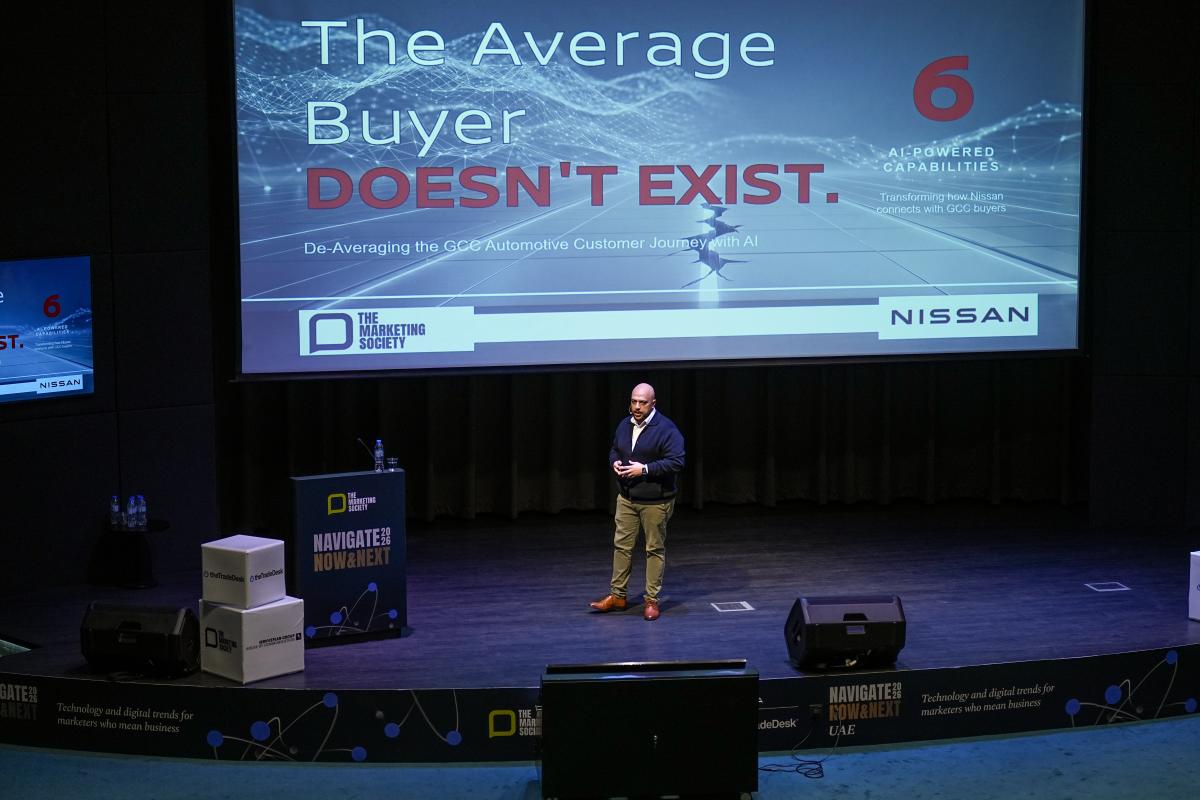
Nissan's session showed the same balance from a different angle. AI and CGI are helping the brand produce faster, reduce costs and personalise communications at scale. But the value is not just in creating more assets. It is in using customer signals effectively, understanding intent and knowing what message is relevant to which person at which moment.
5 biggest takeaways
The two actions I am taking back to my team are simple. The first is to pressure-test whether our brands have a clear and consistent message or voice across everything we put into the market. The second is to ask a tougher question before reacting to trends: do we genuinely belong in this conversation?
Navigate was supposed to be a day about AI.
For me, it ended up being a day about marketers.
Because the more accessible AI becomes, the more valuable judgement becomes. And judgement, creativity and market context remain very human advantages.